
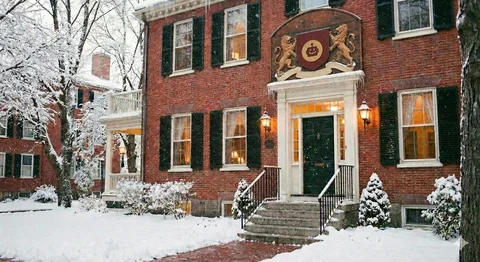
In April 2007, I checked into the Old Court Inn the night before a Drupal training in Providence. I was in a melancholy mood, but the Inn cheered me up. A stately brick building along Providence’s “Mile of History,” I walked into a common area with high ceilings and plaster crown moldings from a more craft-obsessed century. As I walked to my room, I passed an open door, and inside I saw two women sitting on their quilted bedspread, laptops out, working on Drupal. They were Lullabot Angie Byron and soon-to-be Lullabot Addi Berry, and they were so excited about Drupal contribution that it was infectious. Still, they were kind enough to pause and welcome me, and I soon felt like I had made friends.
The next morning, I walked up the hill to the Providence Music Mansion in a piercingly cold wind. And when I came through the door into the warmth—coffee, conversation, people laughing—I had this sudden, unbidden thought: These people are so happy. Lullabot must be a good place to work.
The instructors were people I knew only by their handles from the issue queue: quicksketch, jjeff, metta, eaton, and webchick (Angie Byron, my new friend!)—maintainers of important modules, voices from the Lullabot podcast, and open-source celebrities. I sat in the front row. I wanted to make a good impression. I never could have guessed that I would someday be the CEO of this company. But I knew, even then, that I wanted to work at Lullabot if I ever got the chance.
I went back for another training in 2008. In 2010, when a project management job opened up, I applied.
On January 2, 2026, Lullabot turned twenty years old. Only about one in five digital agencies make it that long. In human terms, that's like reaching ninety. Many agencies of our age have been acquired, merged, rebranded, hollowed out, or reconstituted. There's a Ship of Theseus problem in this industry: if every plank has been replaced, is it still the same ship? Razorfish is over 30 years old, but it has passed through many acquisitions and many identities.
Lullabot, improbably, is still Lullabot.
The story starts in the Drupal issue queue. Matt Westgate had written the e-commerce module. Jeff Robbins reached out for help, found him there, and asked if he could pay Matt just to talk about Drupal—to answer questions about best practices. That was the spark. Teaching and learning could be a business.
Matt was an autodidact who documented everything he learned. He wrote "Pro Drupal Development," one of the first serious books on the platform. Jeff was the promoter, the PT Barnum energy, the brand-builder. Their Lullabot podcast was a phenomenon before Drupal had been commercialized in its modern form. Jeff liked to say that good writing is good thinking, and Lullabot, from the start, was a company that wrote things down—blog posts, documentation, training curricula, books. The combination of deep learning paired with the willingness to share it broadly became the cultural DNA. As former Lullabot Haley Scarpino observed, "Lullabots are the notiest notetakers ever."
Suddenly, Lullabot was consulting for household name clients. MTV-UK called, then Sony Music. But when it came time to implement the recommendations, someone else did the work. Sometimes that work wasn't very good. And sometimes clients would come back to us unhappy, even though our advice had been sound. The realization was simple and uncomfortable: if we wanted to be responsible for outcomes, we had to build the things ourselves.
I joined in 2010 at the start of that effort. My second week was at DrupalCon San Francisco, and I was drowning in imposter syndrome. I'd worked in professional services for seven years, but I'd never worked with clients like Martha Stewart and the NBA. Here I was among people I considered heroes, being introduced to household names as their new PM as though I belonged. And I did belong. Everyone belonged at Lullabot.
The culture assumed good faith and infinite capability. When someone struggled, it was never treated as a problem with the person. It was a documentation gap, a process gap, an education gap. You got taken under someone's wing. My Old Court Inn friend Angie Byron spent hours patiently explaining not just Drupal but how enterprise QA worked, never making us feel like we were wasting her time. Instead, it felt like a mutual exploration of best practices.
Karen Stevenson, the author of Content Construction Kit (CCK), who would eventually become Lullabot's CFO, would conduct deep research dives for whatever she was working on and then automatically write an article to chart a course for all who followed. At Lullabot, every learning was generalized into something the whole community could use. Teaching as a reflex.
There was a "ready-fire-aim" quality to those early years. If you were presenting a workshop, you might be preparing the curriculum the day before. Drupal changed fast. Our recommendations needed to evolve continually. But that urgency kept us learning, figuring things out in real time, and then sharing what we'd figured out.
There was also, in those years, a lot of joy and a little bit of swagger. In 2011, we threw a party at DrupalCon. Jeff's band, Orbit, which had played Lollapalooza in the' 90s, played a concert. We rented an underground venue. We staged a "Geek to Chic" fashion show. I played a nerd, which was not a stretch. I hiked my pants up, taped my glasses, hunched my shoulders, and pretended to be twins with James Sansbury, who is about a foot shorter than I am. Then we danced in a packed crowd while my boss sang on stage. There was, supposedly, a line around the block.
That was also the era when we were becoming known for something else: doing very hard things on a very large scale. In 2009, for the first time, Lullabot came in and kept the GRAMMYs website from going down during the live show. Think about that traffic curve: quiet most of the year, then tens of millions of people over 48 hours. And this was before the cloud era and modern CDNs.
We grew. We signed on to build a new MSNBC.com in 2012 and built a platform that could handle 20 to 30 editors working concurrently on breaking news. Year after year, we kept the Grammy Awards website online during the show. We became known for high-performance Drupal, for handling the kinds of traffic spikes that brought other sites down. NBC led to Bravo, a relationship that continues to this day. We grew 33% in 2014, adding nineteen people in a single year.
Then came harder times in the media industry. Around DrupalCon Nashville in 2018, we were in a tight spot. Drupal 8 adoption had been slow and painful. Migrations from Drupal 7 were taking forever. Media companies weren't using Drupal as much. Many Drupal 7 clients weren't jumping over because the whole architecture had changed—you couldn't just upgrade, you had to migrate. We were struggling for work.
And then, almost simultaneously, two opportunities materialized. The state of Georgia signed a contract with us to replatform more than 80 state agencies. IBM signed for a large-scale engagement on its marketing sites. Both came through around April 2018. It was a turning point. IBM led to work with Apple, New Relic, and DocuSign.
Georgia became our pivot into SLED—state, local, and higher education. From Georgia, we moved on to Iowa, Arizona, Massachusetts, and Maryland. That's what we do today. We learned that we had something to offer in civic digital transformation, something beyond Drupal expertise: the ability to build design systems that could scale across dozens of agencies, creating consistent and accessible experiences for citizens across an entire state.
I took over as CEO in August 2020, first on an interim basis, then permanently. Matt Westgate left to run Tugboat, then retired in 2021. The founders had exited, and the company survived. That transition is what kills most agencies. We made it through.
The pandemic brought volatility—a freeze in ad spending followed by a surge in demand for digital transformation. Like everyone in the digital agency space, we grew, then contracted. 2025 was hard. We did layoffs for the first time in more than a decade. Tugboat spun out as its own company. It was a contraction after years of uncertainty. I don't want to smooth that over. It hurt. We lost good people.
But here's what endures.
Teaching, learning, and contributing back. Lullabots have made over 10,000 commits to Drupal, and maintained key modules over the years from CCK, Date, Form API, and Token to modern contributions like Olivero, Claro, and the recent admin menu project. We’ve contributed not just code, but also helped make Drupal beautiful with our design contributions. We've been makers, not takers. That impulse to solve problems and share the learnings is still here today.
The learning culture that started in the Drupal issue queue is now formalized in an ESOP, an employee stock ownership plan. Lullabot is 100% employee owned. Everyone who works at Lullabot shares in what we're building together. The seeds of that were planted back in 2012, when Matt Westgate started experimenting with open-book management. We'd gather at retreats and study P&Ls and balance sheets together, learning how the business actually worked. He wanted everyone to understand the mechanics of what we were doing. Through that exploration, he found his way to Jack Stack, the "Great Game of Business," and the world of employee ownership. The ESOP didn't happen until 2021, but the philosophy goes back almost to the beginning.
Over the past 20 years, 152 people have worked at Lullabot. Thirty-seven percent of the current team has been here for more than 10 years. Our average tenure is over seven years, which is not normal for this industry. We've been fully remote since day one, before remote was cool, before it was even comprehensible to most companies, and the communication patterns we developed in 2006 (serendipity calls, async chat, video calls, written documentation) are still recognizable in how we work today. The technologies have changed, but the communication architecture remains the same. When I scroll through the list of everyone who's ever been a Lullabot, I can picture every face. That 150-person limit that anthropologists talk about—the number of people a human can really know—we've stayed just inside it. That feels meaningful.
Drupal has changed. The community has professionalized. What was once a gathering of hobbyists is now an industry. AI is reshaping everything, and I don't know whether CMSs will exist in five years in any form we'd recognize. But the impulse to learn, document, and teach remains constant at Lullabot. It's what got us here. It's the only thing I'm confident will get us wherever things are going.
Twenty years is rare. Twenty years while still being yourself is rarer.
To our clients who trusted us with complex problems. To the Drupal community and everything it gave us, and everything we tried to give back. To the 152 people who built this ship, plank by plank, and kept it afloat. Thank you.