---
title: "Updating go1.x Runtime in AWS Lambdas"
url: "/articles/updating-go1x-runtime-aws-lambdas"
type: article
date: 2024-12-04
updated: 2024-12-04
---
# Updating go1.x Runtime in AWS Lambdas
# Updating go1.x Runtime in AWS Lambdas
Learn how to update the Go runtime for a serverless application running on AWS.
By
[ Juampy NR ](/about/juampy-nr)
December 4, 2024
[*We've created a Git repository*](https://github.com/juampynr/aws-runtime-go-update) *containing all the old and new code blocks mentioned in this article. The main branch uses the latest runtime, while the go1.x uses the old runtime. There is a* [*pull request*](https://github.com/juampynr/aws-runtime-go-update/pull/1) *with the set of required changes.*
For many of our projects, Drupal is just one piece of a large and complex puzzle of applications. Some of these applications follow the [serverless architecture](https://aws.amazon.com/serverless/) and such applications:
- Don't require a quick response time.
- Usually run asynchronously.
- Can scale up fast in the cloud.
- Don't require provisioning or managing servers.
Many refer to serverless applications as [lambdas](https://docs.aws.amazon.com/lambda/latest/dg/welcome.html) (a function usually written in Node.js, Go, or Python). However, on top of the lambda, permissions, networking, databases, messaging, logging, and further plumbing are usually needed so the lambda can run successfully.
There are also multiple meanings for "serverless":
- There is [serverless computing](https://en.wikipedia.org/wiki/Serverless_computing) as a cloud computing model.
- There is [serverless on AWS,](https://aws.amazon.com/serverless/) which is the service AWS offers for serverless applications.
- There is the [Serverless framework](https://www.serverless.com/) as an abstraction layer for AWS Serverless, which we use in the sample application below.
While deploying updates to a serverless application on AWS, we encountered an issue with the Go runtime. This article covers how we resolved the problem.
## A sample serverless application
You can browse the application at [GitHub](https://github.com/juampynr/aws-runtime-go-update), but we'll review the main files.
### A Go lambda
Below is a simple lambda function that prints the incoming payload:
```bash
# hello/main.go
package main
import (
"fmt"
"github.com/aws/aws-lambda-go/events"
"github.com/aws/aws-lambda-go/lambda"
)
func Handler(request events.APIGatewayProxyRequest) (events.APIGatewayProxyResponse, error) {
fmt.Println("Received body: ", request.Body)
return events.APIGatewayProxyResponse{Body: request.Body, StatusCode: 200}, nil
}
func main() {
lambda.Start(Handler)
}
```
To run the above in AWS, we need a `serverless.yml` file defining what this lambda needs to run.
### A serverless.yml file
The below file defines how to deploy the above lambda in AWS. It defines the Go runtime and a triggering event via an HTTP POST request to `/hello`.
```yaml
# serverless.yml
frameworkVersion: ^3.39.0
service: hello
provider:
name: aws
runtime: go1.x
package:
individually: true
functions:
hello:
handler: hello
package:
artifact: bin/hello.zip
events:
- http:
path: hello
method: post
```
Notice that Serverless framework is an abstraction layer for AWS Cloud Formation. Upon deployment via `sls deploy`, it will build a [CloudFormation stack](https://docs.aws.amazon.com/AWSCloudFormation/latest/UserGuide/stacks.html) that defines all the resources it needs to run, such as permissions, roles, networking, gateways, etc.
### Build and deploy
In this case, we are using [GNU make](https://www.gnu.org/software/make/manual/make.html) to build and deploy the application:
```bash
# Makefile
build:
env GOOS=linux go build -ldflags="-s -w" -o bin/hello hello/main.go
cd hello; zip hello.zip hello
deploy:
sls deploy
```
However, AWS won't let us deploy this application since it uses the `go1.x` runtime. Let's update it.
### Deployment error
After authenticating in the command line with AWS via `aws configure`, we can deploy our application by running `make build && make deploy`. However, we recently ran into the following error:
```bash
✖ Stack some-stack-example failed to deploy (93s)
Environment: darwin, node 18.17.1, framework 3.31.0 (local) 3.38.0v (global), plugin 6.2.3, SDK 4.3.2
Credentials: Local, "default" profile
Docs: docs.serverless.com
Support: forum.serverless.com
Bugs: github.com/serverless/serverless/issues
Error:
CREATE_FAILED: SomeStackLambdaFunction (AWS::Lambda::Function)
Resource handler returned message: "The runtime parameter of go1.x is no longer supported for creating or updating AWS Lambda functions. We recommend you use the new runtime (provided.al2023) while creating or updating functions. (Service: Lambda, Status Code: 400, Request ID: redacted)" (RequestToken: redacted, HandlerErrorCode: InvalidRequest)
View the full error: https://us-east-1.console.aws.amazon.com/cloudformation/home?region=us-east-1#/stack/detail?stackId=redacted
make: *** [deploy] Error 1
```
The `go1.x` runtime used for Go applications at AWS is no longer supported since December 31st, 2023. The new runtime is `provided.al2023`. Full details and migration docs are available at [Migrating AWS Lambda functions from the Go1.x runtime to the custom runtime on Amazon Linux 2](https://aws.amazon.com/blogs/compute/migrating-aws-lambda-functions-from-the-go1-x-runtime-to-the-custom-runtime-on-amazon-linux-2/).
It took us some reading to figure out what we needed to change in the above `serverless.yml` and why, so we will summarize the changes in the following section.
## Fixing the application
Here is the list of changes required to successfully deploy a Go lambda to AWS. You can see a pull request with the list of changes at .
### In the Go main file
Nothing. This stays as-is, but you can take the opportunity to update to the latest version of [AWS Lambda for Go](https://github.com/aws/aws-lambda-go).
### In the serverless.yml file
Here are the changes we made:
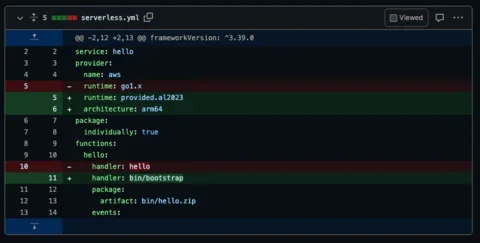
And here is the resulting file:
```yaml
# serverless.yml
service: myservice
provider:
name: aws
runtime: provided.al2023
architecture: arm64
functions:
hello:
handler: bin/bootstrap
package:
artifact: bin/hello.zip
events:
- http:
path: hello
method: post
```
### In the makefile
Here are the changes:
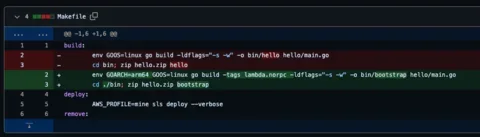
And here is the resulting makefile:
```bash
# Makefile
build:
env GOARCH=arm64 GOOS=linux go build -tags lambda.norpc -ldflags="-s -w" -o bin/bootstrap hello/main.go
cd ./bin; zip hello.zip bootstrap
deploy:
sls deploy
```
### Explanation of the changes
- Changed the architecture to AWS Graviton2 Processor. This processor offers better performance and pricing. See [Migrating AWS Lambda functions to Arm-based AWS Graviton2 processors for details](https://aws.amazon.com/blogs/compute/migrating-aws-lambda-functions-to-arm-based-aws-graviton2-processors/). This is an optional but recommended change.
- Added the `-tags lambda.norpc` option for even better performance and cold starts. This is only available in combination with `GOARCH=arm64`. Full details at [Migrating AWS Lambda functions to Arm-based AWS Graviton2 processors for details](https://aws.amazon.com/blogs/compute/migrating-aws-lambda-functions-to-arm-based-aws-graviton2-processors/). If your application uses the RPC protocol, do not use this tag when building the application.
- Changed the name of the resulting binary from `hello` to `bootstrap`. This is a requirement by AWS: the Go executable that AWS Lambda uses has to be called `bootstrap`. If you have multiple lambdas, we recommend compiling each lambda in its own directory under `bin` and then zip them independently. For example, `hello/main.go` could go into `/bin/hello/bootstrap` and then we would zip `/bin/hello/bootstrap` into `/bin/hello.zip`.
## Deployment
After making the above changes, it's time to build and deploy the stack to AWS again.
First, we build the application:
```bash
$ make build
env GOARCH=arm64 GOOS=linux go build -tags lambda.norpc -ldflags="-s -w" -o bin/bootstrap hello/main.go
cd ./bin; zip hello.zip bootstrap
adding: bootstrap (deflated 59%)
```
Then we deploy it to AWS:
```bash
$ make deploy
sls deploy --verbose
Deploying hello to stage dev (us-east-1)
Packaging
Retrieving CloudFormation stack
Uploading
Uploading CloudFormation file to S3
Uploading State file to S3
Uploading service hello.zip file to S3 (2.05 MB)
Updating CloudFormation stack
Creating new change set
Waiting for new change set to be created
Change Set did not reach desired state, retrying
Executing created change set
UPDATE_IN_PROGRESS - AWS::CloudFormation::Stack - hello-dev
CREATE_IN_PROGRESS - AWS::Logs::LogGroup - HelloLogGroup
CREATE_IN_PROGRESS - AWS::ApiGateway::RestApi - ApiGatewayRestApi
CREATE_IN_PROGRESS - AWS::IAM::Role - IamRoleLambdaExecution
CREATE_IN_PROGRESS - AWS::Logs::LogGroup - HelloLogGroup
CREATE_IN_PROGRESS - AWS::IAM::Role - IamRoleLambdaExecution
CREATE_IN_PROGRESS - AWS::ApiGateway::RestApi - ApiGatewayRestApi
CREATE_COMPLETE - AWS::ApiGateway::RestApi - ApiGatewayRestApi
CREATE_IN_PROGRESS - AWS::ApiGateway::Resource - ApiGatewayResourceHello
CREATE_IN_PROGRESS - AWS::ApiGateway::Resource - ApiGatewayResourceHello
CREATE_COMPLETE - AWS::ApiGateway::Resource - ApiGatewayResourceHello
CREATE_COMPLETE - AWS::Logs::LogGroup - HelloLogGroup
CREATE_COMPLETE - AWS::IAM::Role - IamRoleLambdaExecution
CREATE_IN_PROGRESS - AWS::Lambda::Function - HelloLambdaFunction
CREATE_IN_PROGRESS - AWS::Lambda::Function - HelloLambdaFunction
CREATE_COMPLETE - AWS::Lambda::Function - HelloLambdaFunction
CREATE_IN_PROGRESS - AWS::Lambda::Version - HelloLambdaVersion4V0GocYWXLNAdFoBlPWROv3uiByixVfGmcK0lztT3c
CREATE_IN_PROGRESS - AWS::Lambda::Permission - HelloLambdaPermissionApiGateway
CREATE_IN_PROGRESS - AWS::Lambda::Permission - HelloLambdaPermissionApiGateway
CREATE_IN_PROGRESS - AWS::Lambda::Version - HelloLambdaVersion4V0GocYWXLNAdFoBlPWROv3uiByixVfGmcK0lztT3c
CREATE_COMPLETE - AWS::Lambda::Permission - HelloLambdaPermissionApiGateway
CREATE_COMPLETE - AWS::Lambda::Version - HelloLambdaVersion4V0GocYWXLNAdFoBlPWROv3uiByixVfGmcK0lztT3c
CREATE_IN_PROGRESS - AWS::ApiGateway::Method - ApiGatewayMethodHelloPost
CREATE_IN_PROGRESS - AWS::ApiGateway::Method - ApiGatewayMethodHelloPost
CREATE_COMPLETE - AWS::ApiGateway::Method - ApiGatewayMethodHelloPost
CREATE_IN_PROGRESS - AWS::ApiGateway::Deployment - ApiGatewayDeployment1730185335043
CREATE_IN_PROGRESS - AWS::ApiGateway::Deployment - ApiGatewayDeployment1730185335043
CREATE_COMPLETE - AWS::ApiGateway::Deployment - ApiGatewayDeployment1730185335043
UPDATE_COMPLETE_CLEANUP_IN_PROGRESS - AWS::CloudFormation::Stack - hello-dev
UPDATE_COMPLETE - AWS::CloudFormation::Stack - hello-dev
Retrieving CloudFormation stack
Removing old service artifacts from S3
✔ Service deployed to stack hello-dev (67s)
endpoint: POST - https://redacted.execute-api.us-east-1.amazonaws.com/dev/hello
functions:
hello: hello-dev-hello (2 MB)
Stack Outputs:
HelloLambdaFunctionQualifiedArn: arn:aws:lambda:us-east-1:redacted:function:hello-dev-hello:1
ServiceEndpoint: https://redacted.execute-api.us-east-1.amazonaws.com/dev
ServerlessDeploymentBucketName: hello-dev-serverlessdeploymentbucket-redacted
```
You might get this warning when deploying via `sls deploy`:
```bash
Warning: Invalid configuration encountered
at 'provider.runtime': must be equal to one of the allowed values [dotnetcore3.1, dotnet5.0, dotnet6, dotnet7, go1.x, java17, java11, java8, java8.al2, nodejs12.x, nodejs14.x, nodejs16.x, nodejs18.x, provided, provided.al2, python3.7, python3.8, python3.9, python3.10, ruby2.7]
Learn more about configuration validation here: http://slss.io/configuration-validation
```
Serverless 3 does not recognize the runtime `provided.al2023`. The closest it knows about is `provided.al2` but it's not worth it to use `provided.al2` since its EOL is June 2025. Therefore, you can keep using Serverless 3 and ignore that warning. Alternatively, you can upgrade to Serverless 4, but that requires a user subscription, so it's up to you.
## Conclusion
The AWS document [Migrating AWS Lambda functions from the Go1.x runtime to the custom runtime on Amazon Linux 2](https://aws.amazon.com/blogs/compute/migrating-aws-lambda-functions-from-the-go1-x-runtime-to-the-custom-runtime-on-amazon-linux-2/) is excellent. However, the documentation covers many scenarios, so figuring out what to change in a `serverless.yml` file can be challenging. On top of that, there is the chance to update the architecture via [Migrating AWS Lambda functions to Arm-based AWS Graviton2 processors for details](https://aws.amazon.com/blogs/compute/migrating-aws-lambda-functions-to-arm-based-aws-graviton2-processors/), which requires further reading and filtering to apply it to a specific case.
Hopefully, this article helped you cut through the noise.
### Acknowledgments
[This post from the Serverless website](https://www.serverless.com/blog/framework-example-golang-lambda-support) had a very simple Go lambda that we used for our example.
Published in:
- [ System Administration ](/topics/system-administration)
You must have JavaScript enabled to use this form.
## Get in touch with us
### Tell us about your project. We'd love to hear from you!
First Name
Last Name
Your email address
Your organization
How you heard about us
Tell us more
Leave this field blank